AGIBOT Declares 2026 'Deployment Year One' with Next-Gen Humanoid Launch
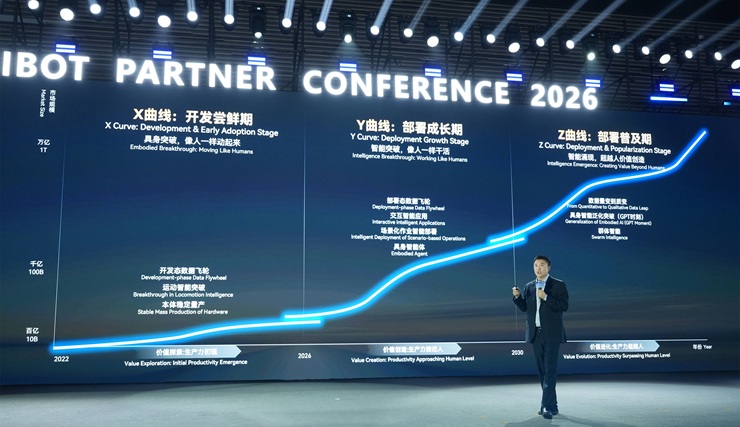
The landscape of artificial intelligence is officially moving beyond digital screens and into the physical world. At the 2026 AGIBOT Partner Conference held in Shanghai on April 18, 2026, the robotics titan declared 2026 as "Deployment Year One," marking the transition of embodied AI into large-scale commercial use. The announcement was punctuated by the introduction of a new full-series portfolio of robots designed to integrate seamlessly into human workflows.
Central to this launch is AGIBOT’s "One Robotic Body, Three Intelligences" architecture. This framework unifies locomotion, manipulation, and interactive intelligence, allowing robots to not only move with human-like agility but also to understand and execute complex tasks autonomously. The company unveiled several flagship platforms, including the AGIBOT A3, a high-performance humanoid standing 173 cm tall, and the AGIBOT X2, a compact bipedal robot engineered for high-agility interactions in the service and entertainment sectors.
The scale of this shift is reflected in AGIBOT's manufacturing milestones. As of April 2026, the company has officially rolled out its 10,000th robot, with production speed accelerating four-fold in just the last three months. These systems are no longer just prototypes; they are being deployed in real-world environments ranging from electronics manufacturing lines at Longcheer Technology to hospitality and retail spaces globally. To support this ecosystem, AGIBOT also launched AIMA (AI Machine Architecture), an open-stack developer platform intended to lower the friction for third-party industrial integration.
This surge in physical AI is also reshaping the underlying cloud infrastructure. While GPUs have long been the focus, industry analysts are noting a "CPU crunch" as inference-heavy workloads for autonomous agents begin to strain system-level constraints, prompting a new wave of investment in data center processing power specifically tailored for edge-based embodied intelligence.
Sources:
- PR Newswire: AGIBOT Unveils New Generation of Embodied AI Robots and Models
- The Robot Report: AGIBOT Deploys Humanoid Robots in Precision Manufacturing
- Digitimes: AI Drives CPU Crunch, Lifting Data Center Demand
Justification of Relevance:
- PR Newswire: Provides the primary, high-authority corporate announcement and technical specifications for the AGIBOT 2026 launch.
- The Robot Report: A Tier-2 specialized authority that verifies the real-world industrial deployment and performance metrics of the new AI systems.
- Digitimes: Offers critical real-time industry commentary on how these AI advancements are impacting the broader cloud computing and data center hardware market.